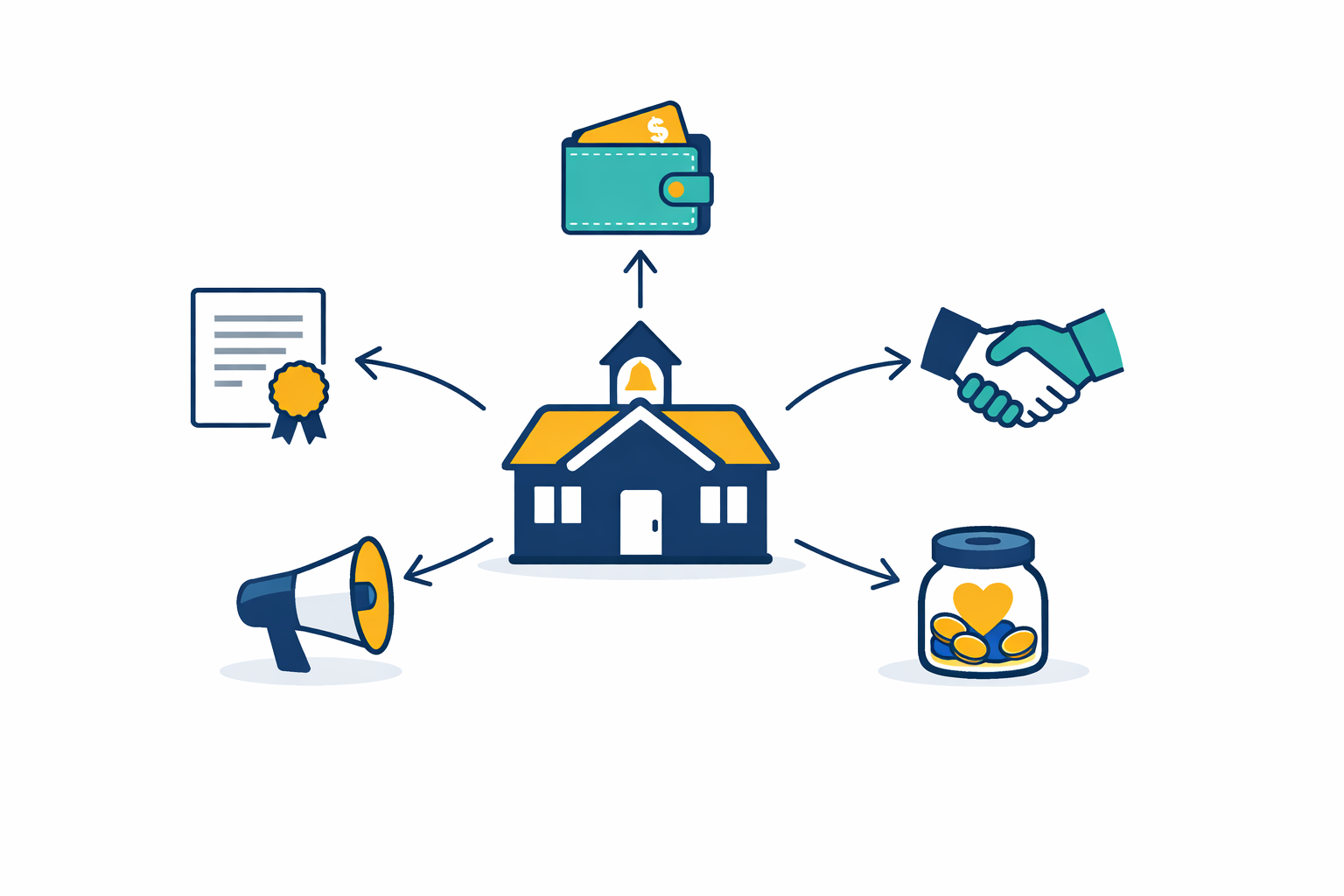
Microschool funding comes from diverse sources including dedicated grants, state education savings accounts, corporate programs, and crowdfunding platforms. The best starting point for most founders is VELA, which offers grants up to $10,000 specifically for alternative education projects like microschools. Beyond VELA, microschool founders can access state ESA programs averaging $7,500 per student, federal STEM education funding, corporate giving initiatives, and specialized foundation grants.
At KaiPod, we’ve helped hundreds of microschool founders navigate the funding landscape through our KaiPod Catalyst training program. Most successful founders combine multiple funding sources, using seed grants for startup costs while building toward tuition-based sustainability. Nonprofit microschools have access to the widest range of grant opportunities, though for-profit schools can still access state ESA programs, corporate giving, crowdfunding, and select federal grants.
The funding options below are organized by type, starting with the highest-value opportunities for microschool founders. Each listing includes eligibility requirements, typical award amounts, and application timing to help you prioritize your funding strategy.
Quick Reference: Types of Microschool Funding
| Funding Type | Best For | Typical Range | Application Timing |
| VELA grants | All microschools (early-stage to expansion) | $2,500-$250,000 | Year-round after joining network |
| Yass Prize | Established, innovative schools | $100,000-$1,000,000 | March-April applications |
| State ESA programs | Per-student operating funds | $5,000-$11,000 per student | Varies by state, often year-round |
| Federal STEM grants (PLTW) | STEM-focused programs | Covers fees + equipment | November-December deadlines |
| Corporate giving programs | Community-based projects | $250-$100,000 | Quarterly or rolling |
| Crowdfunding | Specific projects/equipment | $500-$5,000 | Ongoing, 30-40 day campaigns |
| Named foundations | Specialized focus areas | $100-$50,000 | Varies, often annual |
| Faith-based funding | Religious microschools | $5,000-$100,000+ | Varies by foundation |
Top Microschool Funding Source: VELA Education Fund
VELA is a community of entrepreneurs dedicated to providing funding for alternative education projects. They’re especially focused on supporting small learning environments, making them the top source of microschool funding. Since 2019, VELA has distributed over $24.2 million through more than 2,000 grants across all 50 states.
VELA operates through a tiered funding system designed to support microschools at every stage:
Micro Grants: $2,500 or $10,000 for early-stage founders getting their schools off the ground.
Next Step Grants: Up to $50,000 for Micro Grant recipients ready to expand their reach.
Bridge Grants: Up to $250,000 for organizations prepared to scale their model widely.
How to Apply
Founders must first join the VELA Founders Network (free membership) before accessing funding opportunities. Applications are accepted on a rolling basis throughout the year. Learn more about VELA’s eligibility criteria.
Eligibility Requirements
VELA funds organizations that serve K-12 learners outside traditional public, private, or charter schools. You must be operational (not in the planning phase), have proof of concept, and be U.S.-based. Traditional schools, daycare-only programs, and international organizations are ineligible.
The application process is competitive—for their 2022 Next Step grants, 550+ pre-applications resulted in just 32 recipients, or approximately 6% of initial applicants. However, the free network membership provides valuable connections and resources even before you receive funding.
Yass Prize: Education’s Million-Dollar Recognition
The Yass Prize program supports organizations that provide sustainable, transformational educational experiences outside the traditional school framework. Known as the “Pulitzer of Education Innovation,” the prize has awarded over $46 million since its founding in 2021.
Award Amounts
Award amounts vary by year. For the 2025 competition:
- Grand Prize Winner: $1,000,000
- Finalists: $250,000 each (4 finalists)
- Semifinalists: $100,000 each (18 semifinalists)
Note: Previous years had different tier structures. The amounts and number of awards at each level can change annually.
KaiPod Learning Success Stories
KaiPod Learning has been recognized multiple times by the Yass Prize:
- 2022 Semifinalist: KaiPod Learning participated in the Yass Prize accelerator program, receiving funding and mentorship that helped launch the Catalyst training program
- 2025 Texas Education Freedom Award: KaiPod Learning was one of 11 Yass Prize alumni selected to receive funding to expand microschool options across Texas, with plans to incubate at least 50 new microschools in the state
Path of Life Learning, founded by Mercedes Grant (a KaiPod Catalyst graduate), won a 2025 Finalist award ($250,000) to create the POLL Military Microschools Network serving military families. Learn more at yassprize.org/awardees/path-of-life-learning.
State-Specific Awards
The Yass Prize also awards funding in select states. The Texas Education Freedom Award was created in 2025 following passage of Texas’s ESA program, providing funding to 11 Yass Prize alumni (including KaiPod Learning) to launch or expand innovative school models across Texas.
Application Process
Applications typically open in March with mid-April deadlines. The multi-round process includes rigorous evaluation by 500+ judges, moving from thousands of applications to a select group of contenders who participate in a business accelerator program before winners are announced in December.
Organizations must demonstrate S.T.O.P. principles: Sustainable operations, Transformational impact, Outstanding results, and Permissionless innovation.
Alumni Awards Program: In 2025, the Yass Prize launched an Alumni Awards Program specifically for past awardees, providing additional funding opportunities for proven education innovators to expand their models.
Learn more at yassprize.org/about.
State Education Savings Account Programs
State ESA programs represent the most reliable source of per-student funding for microschools. As of 2025, 38% of microschools now receive state school choice funds, up from 32% in 2024. These programs allow families to use state education dollars for approved education expenses, including microschool tuition.
Arizona Empowerment Scholarship Accounts
Arizona operates the nation’s most expansive universal ESA program with 98,244 students enrolled as of December 2025.
Award Amount: $7,000-$8,000 annually for standard students, with significantly higher amounts for students with disabilities
Eligibility: Universal—all Arizona students are eligible
Application: Ongoing at esaonline.azed.gov with 30-day processing times
Florida Tax Credit Scholarships
Florida’s FTC and FES-EO programs serve families statewide with universal eligibility.
Award Amount: $7,400-$11,950 depending on county and grade level (Monroe County pays highest)
Eligibility: Universal as of 2023
Application: Opens February 1 annually through Step Up For Students
Texas Education Freedom Account (Launching 2026)
Texas launches its massive ESA program in Fall 2026—the largest initial school choice program any state has launched.
Award Amount: Approximately $10,000-$10,900 per student (students with disabilities may receive up to $30,000 additional)
Eligibility: Universal program with $1 billion appropriation potentially serving 80,000-100,000 students initially
Application: Opens February 4, 2026
West Virginia Hope Scholarship
West Virginia’s Hope Scholarship explicitly includes microschools as eligible providers.
Award Amount: $5,267.38 per student for 2025-26
Eligibility: Universal eligibility beginning 2026-27 (currently has income restrictions)
Participating Schools: 233 participating nonpublic schools and microschools serving 10,530 students
Application: Opens annually in March
Virginia Education Improvement Scholarships Tax Credits
Virginia’s program operates through an indirect tax credit model rather than direct payments.
Award Amount: Average ~$2,800 per student
Eligibility: Income limits of 300% federal poverty level ($93,600 for a family of four), with special needs students eligible at 400% FPL
Annual Cap: $25 million statewide
For families considering your microschool, knowing which states offer ESA programs can make the difference in affordability. Visit EdChoice to research current programs in your state.
Federal Education Funding for Microschools
While most federal K-12 education grants do not directly fund private schools or microschools, important pathways exist for STEM-focused programs.
Project Lead the Way (PLTW)
PLTW provides the most accessible federal-adjacent funding for STEM education. The program has distributed over $75 million to more than 6,600 schools over 10 years.
Award Amount: Covers participation fees, professional development, and equipment costs
Eligibility: Nonprofit private schools are explicitly eligible alongside public schools
Application Deadlines: November 7 and December 5, 2025 for 2026-27 school year
Focus: PreK-12 STEM and Career Technical Education programs
PLTW recommends applying during the fall semester to be considered for as many grant opportunities as possible, as they have partnerships with multiple corporate sponsors. Learn more at pltw.org/investment/funding-grants.
Innovative Technology Experiences for Students and Teachers (ITEST)
Microschools with a strong focus on STEM education may qualify for ITEST grants supported by the National Science Foundation.
Award Amount: $500,000-$3.5 million for larger projects
Important Note: K-12 schools cannot apply directly. You must partner with eligible organizations like universities or nonprofits who serve as the lead applicant.
Focus: Programs that build STEM knowledge and interest, especially for diverse, underserved populations
Application Period: Through August each year for the following year’s awards
U.S. Department of Education
The federal government has millions of dollars available for education through various grant programs. Register with the System for Award Management (SAM), then use ed.gov/fund/grants-apply.html to find potential grant opportunities.
Important Note: Most Department of Education grants fund public school districts or state education agencies, not individual private schools. However, private school students may receive equitable services through Title programs (Title I, II, III, and IV) where your local public school district provides proportional services to eligible private school students.
Corporate Giving Programs for Microschools
Hundreds of corporations have charitable giving organizations, though not all support education initiatives. The programs below have either funded education projects previously or list education as a major interest area.
Walmart Spark Good Local Grants
Walmart offers the most accessible corporate option for microschools, explicitly including charter schools and nonprofit private schools.
Award Amount: $250-$5,000
Eligibility: Nonprofit organizations with NCES school numbers, charter schools, and nonprofit private schools
Application Timing: Quarterly cycles (next: March 10-April 15, 2025)
How to Apply: Visit walmart.org/spark-good-local-grants-guidelines
Honda USA Foundation
Honda provides substantial awards for STEM education but with geographic restrictions.
Award Amount: $25,000-$100,000
Eligibility: Schools with NCES listings in Honda operation areas (Alabama, California, Florida, Georgia, Indiana, Michigan, North Carolina, Ohio, Texas)
Current Status: Applications closed until Fall 2026
Focus: STEM education and environmental programs
Website: csr.honda.com/community/honda-giving
Lowe’s Charitable and Educational Foundation
Lowe’s Toolbox for Education offers grants for facility improvements and STEM programs.
Award Amount: $2,000-$100,000
Eligibility: Public schools, charter schools, and parent groups with 501(c)(3) status. Private microschools may qualify through parent organizations.
Focus: Facility improvements, STEM programs, skilled trades education
General Motors Corporate Giving
GM focuses on STEM education in communities where they operate facilities.
Award Amount: Varies (GM provided $60 million to 400+ nonprofits in 2022)
Application: Letters of inquiry accepted through September
Geographic Focus: Detroit and communities with GM facilities
Website: gm.com/commitments/corporate-giving
Note: Primarily supports supplementary out-of-school STEM programs rather than school operations
Sony Social Responsibility
Sony’s Create Action program supports STEAM education programs.
Award Amount: $50,000 cash plus $50,000 in Sony products to 10 organizations annually
Eligibility: Organizations with less than $500,000 in annual donations preferred
Focus: STEAM education programs serving underserved communities
Website: sony.com/social-responsibility/giving-guidelines
Voya Foundation Grants
Award Amount: $2,500-$100,000
Focus: STEM education (K-8) and financial literacy (9-12)
Application: Year-round, though primarily works with established partners
Website: voya.com/page/voya-foundation
Google For Education and Other Tech Giants
Google: Ad Grants explicitly exclude schools from nonprofit programs. Learn more at edu.google.com/giving
Microsoft: Excludes schools from standard nonprofit technology programs
AT&T Foundation: Operates by invitation only with focus on workforce development
Target Foundation: Mostly invitation-only except for Target Circle community voting (typically $500-$5,000)
State Street Foundation: Focuses on ages 14+ with grants typically $25,000-$50,000. Visit statestreet.com/state-street-foundation
BIC Corporate Foundation: Works primarily through NGO partnerships with limited U.S. direct grantmaking. Learn more at corporate.bic.com/bic-foundation
Visit each organization’s website to learn if they’re currently accepting applications or letters of interest.
Named Foundation Grants
These foundations support education initiatives with verified current details as of 2025:
Mockingbird Foundation
The Mockingbird Foundation funds music education programs for children and young adults.
Award Amount: $100-$10,000
Eligibility: Programs serving children 18 and under with 501(c)(3) status or government entity. Religious programs ineligible.
Application Deadline: January 15 annually
Note: Extremely competitive—funds fewer than 1% of inquiries. Submit an inquiry form at mbird.org to see if they’re interested in your full proposal.
Charles Lafitte Foundation
This charitable organization funds K-12 education projects including special education, at-risk students, and innovative teaching.
Award Amount: Typically ~$5,000 (range: few thousand to $1 million for exceptional projects)
Eligibility: Prefers organizations with overhead under 15%
Geographic Focus: New Jersey, Florida, New York
Application: Accepted any time through their website describing specific projects with established budgets and measurable impacts
Saxena Family Foundation
This foundation supports STEM education programs, especially those targeted toward girls.
Award Amount: $5,000-$50,000
Eligibility: 501(c)(3) public charities only
Geographic Focus: California, Massachusetts, New York, Texas
Application: Rolling basis year-round at [email protected] or visit saxenafamilyfoundation.com
Change Happens Foundation
This family foundation focuses on science, the environment, and innovative education.
Award Amount: Varies based on project
Eligibility: 3-year history of 990 forms required
Geographic Priorities: Iowa, San Francisco Bay Area, Santa Barbara County, Puget Sound, Portland
Application: Start by sending a letter of inquiry to changehappens.us. If interested, you’ll be invited to submit a full proposal.
Snapdragon Book Foundation
If your microschool’s library will help support children in disadvantaged communities, Snapdragon donates books to fill it.
Award Amount: $500-$2,200+
Eligibility: Public, private, and experimental schools are explicitly eligible—one of the few programs that includes private microschools for library funding
Application Period: November to February each year at snapdragonbookfoundation.org/application
Note: 100% of donations go directly to schools for books
Faith-Based Funding for Religious Microschools
For microschools with religious affiliations, denomination-specific foundations provide important funding sources.
Herzog Foundation (Christian Schools)
Herzog Foundation represents the primary Christian school funder, having provided $2.3+ million to six Christian schools in 2023 alone for capacity expansion and growth.
Focus: Supporting K-12 Christian education
Award Range: Substantial multi-year grants for school expansion
Website: herzogfoundation.com
The Koch Foundation (Catholic Schools)
Award Range: One-year grants supporting Catholic education
Geographic Focus: Financially-distressed areas
Application Period: January 1-May 1 annually
Website: thekochfoundation.org
Jewish Education Funding
Jewish day schools have access to significant funding sources:
UJA-Federation of New York: New $15 million, 3-year pilot providing up to $20,000 per student for first-time day school enrollees
Samis Foundation (Washington State): Day school affordability grants with $16,350 tuition cap for families earning up to $350,000
Local Jewish Federations: Most major cities have Jewish federations that support Jewish education—contact your local federation for opportunities
Major Philanthropic Funders (By Invitation)
Walton Family Foundation: Does not accept unsolicited proposals but has supported 2,400+ school startups since 1997 with $424 million. Their “Big Push for Small Schools” initiative specifically supports microschools.
Stand Together/Charles Koch Foundation: Actively supports microschool incubation through VELA (see above) and other initiatives but primarily works through established partnerships.
Community Foundation Grants
Community foundations offer localized funding opportunities in nearly every region. These foundations typically offer education grants ranging from $1,000-$15,000, with larger initiatives reaching $25,000 or more.
How to Find Your Local Community Foundation
Use the Community Foundation Locator at cof.org to identify foundations in your area. Most community foundations support local education initiatives and may be more accessible than national foundations.
Example Programs
Community Foundations of Hudson Valley: Fund for Excellence in Education provides up to $2,500 for K-12 teachers in public, private, and parochial schools in Dutchess, Orange, Putnam, and Ulster counties.
Local United Ways: Many United Way organizations support education initiatives in their communities through competitive grant programs.
Community foundations often have strong relationships with local donors interested in supporting education innovation in their own backyards. Building relationships with program officers can lead to multi-year funding partnerships.
Crowdfunding for Microschools
While crowdfunding shouldn’t be your primary funding source, it can effectively raise money for specific projects or equipment needs.
Platform Comparison
DonorsChoose: Achieves 75-77% success rates for education projects—nearly triple general crowdfunding platforms. However, it serves only public schools and public charter schools. Private microschools are ineligible. Visit donorschoose.org.
Adopt a Classroom: Similar to DonorsChoose, this platform supports teachers but is limited to public schools. Visit adoptaclassroom.org.
GoFundMe: Accepts private school fundraising with overall success rates around 27%. Education campaigns average $2,500 raised. Fees total 2.9% + $0.30 per donation. Visit gofundme.com.
Kickstarter: Sees 42% overall success rates but education is not a top-performing category. The all-or-nothing model charges 5% platform fee + 3% + $0.20 per pledge only if successful. Visit kickstarter.com.
PledgeCents: School-focused platform with 3% processing fee and features designed specifically for educational fundraising.
Crowdfunding Best Practices
Research shows several factors dramatically increase success rates:
Campaign Length: 30-40 days is optimal—longer campaigns lose momentum
Video: Campaigns featuring videos raise 4x more than those without
Updates: Posting updates every 5 days correlates with 3x more raised
Early Momentum: Reaching 30% funding in the first week dramatically increases success probability
Clear Goals: Be specific about exactly what you’re funding (classroom library, STEM equipment, playground upgrades) and how donated money will be spent
Personal Connection: Share your story and vision authentically. People support people, not just projects.
For private microschools, GoFundMe, Fundly, or PledgeCents represent the best crowdfunding options since DonorsChoose excludes private schools. Set realistic goals of $2,500-$5,000 for first campaigns.
Accountability Matters
Hold yourself accountable to donors, especially if you hope to solicit donations again in the future. Share updates on how funds were used and the impact they made. This transparency builds trust for future fundraising efforts.
Ready to Start Your Microschool?
Securing funding is just one step in launching your microschool. At KaiPod, our Catalyst training program provides comprehensive guidance on grants, fundraising, business planning, and everything else you need to open your doors.
Through Catalyst, you’ll get:
- Expert coaching on grant writing and fundraising strategies
- Access to our network of 150+ microschool founders who have successfully secured funding
- Done-for-you business plan templates that funders expect to see
- Two years of post-launch support as you build financial sustainability
Our Catalyst graduates launch microschools at 6 times the national average rate, and we’ve helped founders across more than 30 states secure the funding they need to make their vision real.
Securing funding is just one piece of the puzzle. If you are at the beginning of your journey, see our Complete Guide to Starting a Microschool for a step-by-step walkthrough.
Sign Up for Catalyst to get comprehensive support for your microschool journey, or Download our Financial and Fundraising Guide to start mapping out your funding strategy today.
For families looking for a microschool, visit our Microschool Finder to discover learning environments where kids truly love school.