Table of Contents
- Your Brand Is More Than a Logo
- How Families Actually Choose Schools
- Stage 1: Getting Found (Awareness)
- Stage 2: Capturing and Keeping Interest
- Stage 3: Building Trust Through Events
- Stage 4: Getting to Yes (The Decision Stage)
- Frequently Asked Questions About Microschool Marketing
- Building Marketing Into Your Microschool From the Start
Marketing a microschool works differently than marketing most businesses, and the difference is worth understanding early. Families choosing a school are making one of the highest-stakes decisions of their lives, and they move through that decision slowly, emotionally, and on their own timeline. Founders who build strong enrollment understand this and show up consistently across the right channels rather than defaulting to paid ads or waiting for a perfect brand before they start.
Roughly 75% of U.S. families considered, searched for, or enrolled at least one child in a new or different school last year, and 48% of K-12 families are actively open to alternatives. The demand is real. The gap, for most microschools, is awareness.
At KaiPod Learning, we’ve worked alongside 150+ microschool founders across more than 30 states, and we’ve seen the same pattern: founders who understand how parents choose a school tend to see stronger enrollment.
This guide covers each stage of that journey, from building a brand families recognize and trust, to understanding how school decisions actually get made, to earning referrals that boost enrollment..
Your Brand Is More Than a Logo
Many founders spend more time thinking about their logo than their brand. That’s understandable. Logos are tangible and satisfying to create. But a logo’s only real job is recognition. Everything else that shapes how families find, evaluate, and ultimately choose your school runs much deeper.
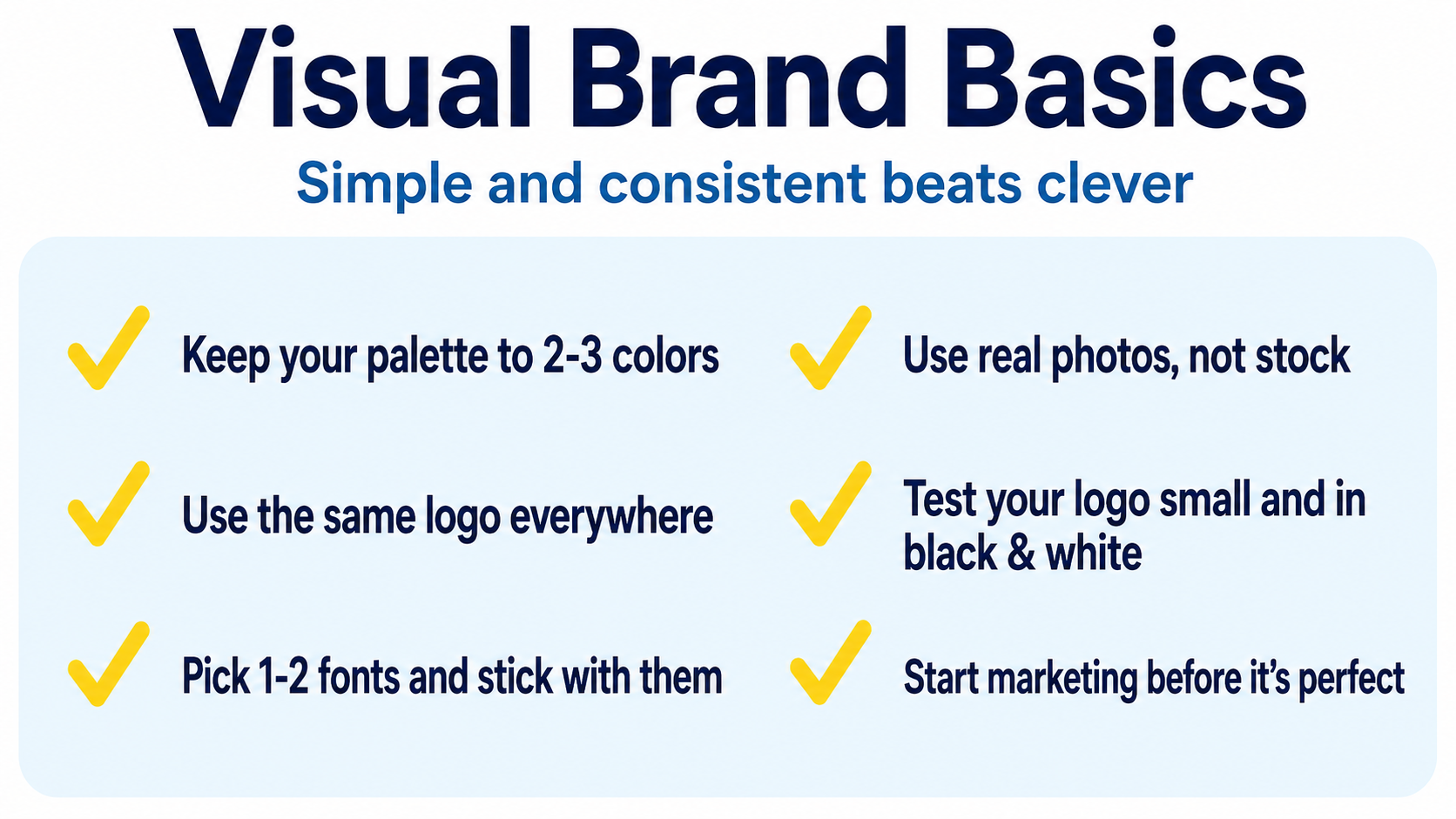
Your brand is the sum of your values, your educational philosophy, your communication style, and the way you convey these at every touchpoint with a family.
Think of brand as the bridge between your intention as a founder and the experience of a parent. Its strength is based on clarity, consistency, and trust. A founder who shows up consistently, responds personally, and clearly communicates the “why” behind their school is creating a strong “brand” experience for their families.
Before putting energy into any marketing channel, it’s worth getting clear on five things:
- Who you’re for (and who you’re not for). Every microschool serves a specific kind of family. Families seeking rigorous academics with flexibility. Neurodivergent learners who need a different approach. Families who want a tight-knit community. Project-based learning advocates. When you’re specific about who you’re for, your messaging gets sharper, and the right families recognize themselves in it.
- The need you meet. What problem keeps the families you want to serve up at night? “My child isn’t seen.” “My child is bored and disengaged.” “My child is anxious about school.” “My child learns differently.” Strong brands are built around solving something specific, not offering something for everyone.
- What you promise. A brand promise isn’t a tagline. It’s the one thing families can count on you to deliver, every single time. Not what sounds good, but what you’re willing to be held accountable for. “Every child will be known and seen as an individual.” “Families will have transparency and partnership in their child’s learning.” “Students will learn through real-world projects, not just textbooks.” Your brand promise is the north star that guides every decision you make about how your school operates.
- How you show up. Your school’s personality (warm and nurturing vs. rigorous and disciplined, playful and creative vs. structured and traditional) shapes everything from how you answer emails to what your space looks like. Getting clear on this helps you attract families who share your values and have honest conversations with those who are looking for something different.
- Why you started. Your founder story is where your brand begins. It’s what answers the quiet question every family is asking: “Why should I trust you?” When families hear your story, they’re not just learning about your background. They’re looking for evidence that this school was built for people like them.
How Families Actually Choose Schools
Choosing a school isn’t like buying a product. The path families take from first hearing about a microschool to enrolling their child is rarely a straight line.
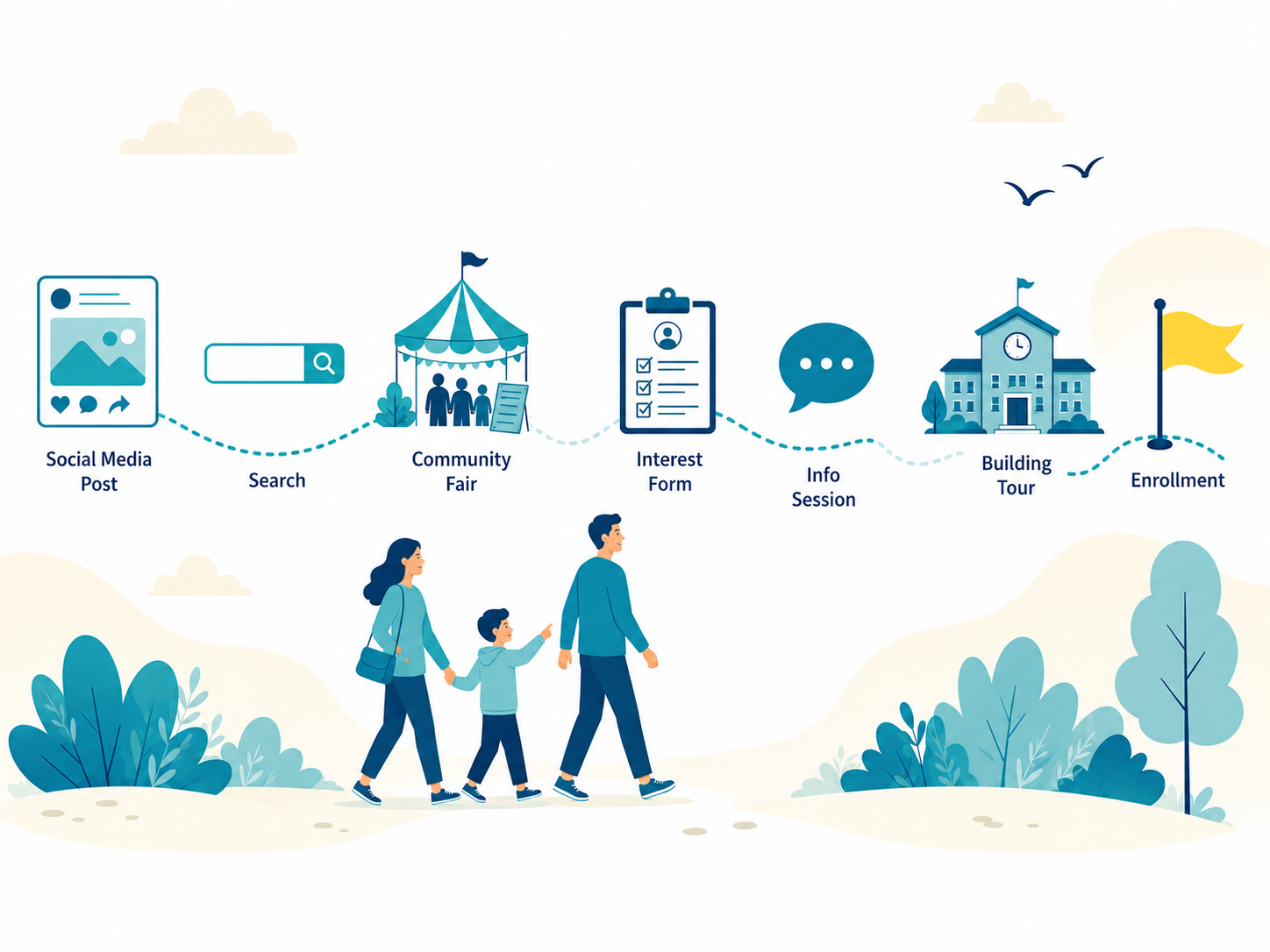
It looks more like this: a family sees a Facebook post about a local microschool. They mention it to a friend. A few weeks later they search “microschools near me” and land on a couple of websites. Life gets busy, they go quiet. Then, two months later, they attend a community fair, pick up a flyer, and this time they fill out an interest form. They attend an info session. They tour two schools. They go quiet again. Then they enroll.
Tyton Partners’ research identifies “fear of the unknown” as the most powerful barrier preventing families from completing the move to a new school, with 40% citing awareness of their options as the primary obstacle. These families would genuinely consider a microschool. They just can’t find one, or they don’t know enough to feel confident making the leap.
Three realities shape how this decision-making process actually works:
Silence doesn’t mean no. When a family goes quiet after expressing interest, they’re almost always still deciding, not disqualifying you. They’re gathering information, talking things over with their partner, sitting with uncertainty. Staying consistently present through that silence matters more than chasing a response.
Repetition is how trust forms. Families often need multiple exposures before they feel ready to act. A Finalsite survey of more than 350 school leaders found that 79% of schools reach out to prospective families at least five times during the enrollment process, and note that even five is on the low end. In a high-stakes decision like school choice, the number of meaningful touchpoints families need before they act is almost certainly higher.
Deeper questions emerge when the decision gets real. Early in the process, families are asking “Is this a legitimate option?” Later, when they’re seriously considering it, they’re asking “Is this the right fit for my specific child?” Those questions need different things from you at different moments.
The Enrollment Funnel
A microschool isn’t an impulse decision. Families typically move through five stages before they enroll, and what they need from you at each stage is different:
| Stage | What Families Are Thinking | Your Job |
| Awareness | “I didn’t know this was an option.” | Be visible |
| Interest | “This might work for my child.” | Be clear |
| Evaluation | “Are they legitimate?” | Build confidence |
| Decision | “Are we ready to commit?” | Reduce uncertainty |
| Enrollment | “We’re in.” | Reinforce and welcome |
The most common marketing mistakes happen when founders send the same message regardless of where a family is in that journey. Awareness-stage families need repetition and visibility. Decision-stage families need clarity and a concrete next step. Using enrollment language (“Apply now!”) with someone who just heard your name is one of the most common reasons microschool outreach stalls.
Four Core Channels
Four channels do the most work across the enrollment journey, and each maps to a different stage:
- Local visibility (offline and online) is your primary awareness tool. It’s how families find you when they’re searching.
- Social media is your interest tool. It’s how families get a feel for who you are and whether your approach resonates before they ever reach out.
- Events are your trust tool. They’re where real relationships start, and where the most significant jump in family confidence typically happens.
- Word of mouth is your decision tool. When families are getting serious, personal recommendations carry more weight than anything else you can offer.
Most of the marketing work founders do comes down to three things: being findable, being clear, and being trustworthy. Each channel serves one of those goals. None of them work in isolation.
Stage 1: Getting Found (Awareness)
Awareness means more than being seen once. It means being seen, being remembered, and eventually being mentioned by someone a family trusts. A single post, yard sign, or event won’t create awareness on its own. Awareness builds in layers, over time, through repetition.
A useful way to think about it: awareness is a pyramid with three layers.
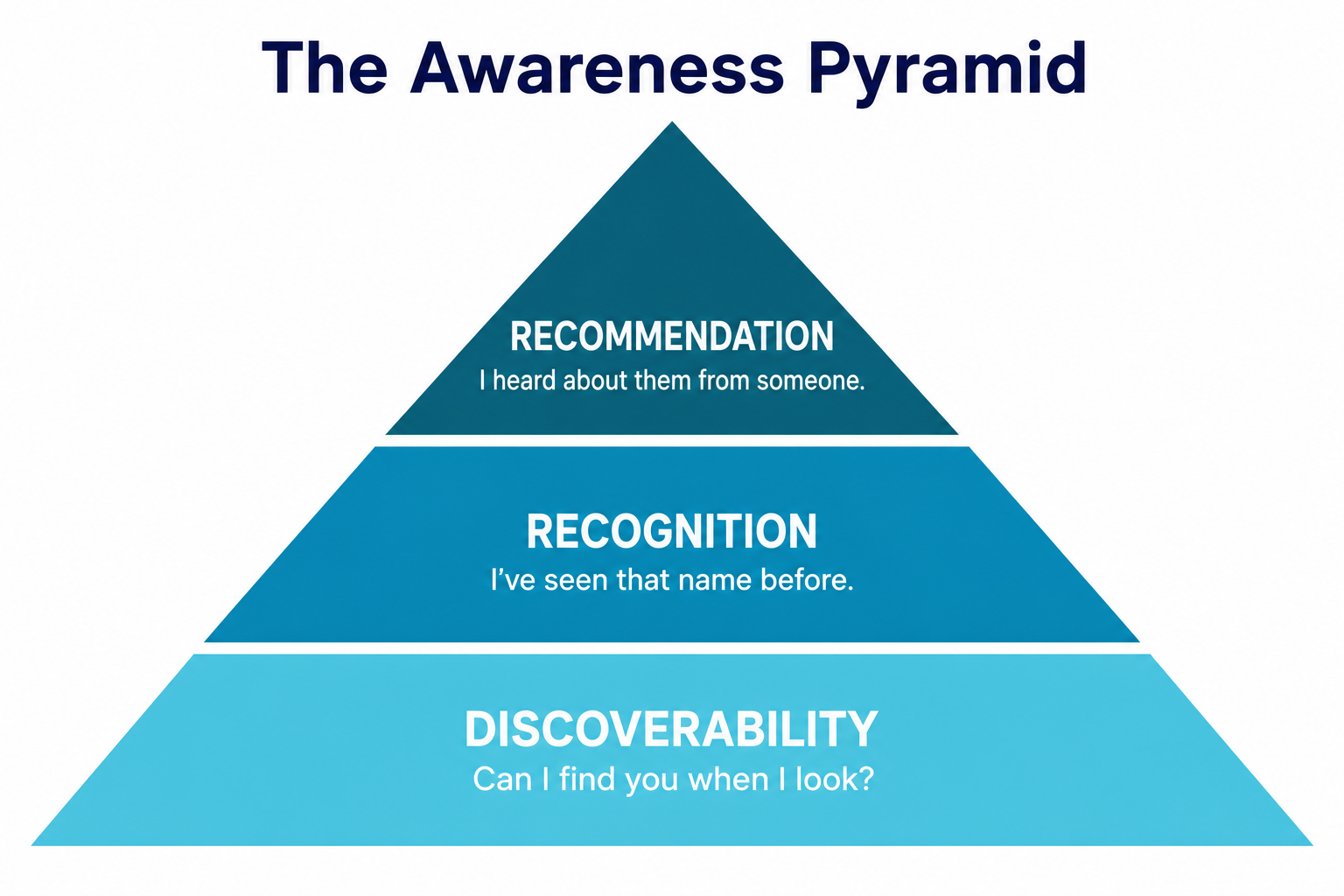
Discoverability is the foundation: “Can I find you when I look?” This is what happens in Google search, maps, local directories, and school choice platforms. What matters here is that you show up at all, your information is accurate, and your message is clear. If someone searches “microschool near me” and you don’t appear, everything else in your marketing plan is harder.
Recognition is the middle layer: “I’ve seen that name before.” This is what happens through repeated presence in local Facebook groups, Instagram, community newsletters, and at events. What matters here is repetition, consistency, and genuine participation, showing up in the same places regularly enough that your name starts to feel familiar.
Recommendation is the top: “I heard about them from someone.” This is what happens through parent conversations, therapist referrals, enrichment providers, homeschool networks, and community leaders. What matters here is relationship-building, clear positioning, and following up well.
It’s easy to overlook discoverability in the early stages. Getting your Google Business Profile set up, listing your school in local directories, and appearing on school choice platforms is unglamorous foundational work, but it makes everything else possible.
Physical Visibility
Being physically visible in your community is underrated and often one of the fastest ways to build recognition. Car magnets, yard signs, flyers in local businesses, library bulletin boards, and a branded presence at farmers markets and community events all put your name in circulation through low-cost, high-repetition channels. These aren’t flashy, but they compound.
Digital Visibility
On the digital side, a few things matter most:
Your Google Business Profile is often the first place families go after they hear your name. Set it up, fill it out completely, and add photos regularly, since activity signals credibility to both search algorithms and families doing their research.
Local Facebook groups and Nextdoor are where many families in your area are already talking about school options. Being a helpful, recognizable voice in those conversations, not advertising but just being genuinely present, builds recognition over time.
Community calendars and school choice directories are easy wins. If someone searches for alternative schools in your area, you want to be there.
Partnerships
One of the most underutilized awareness strategies is simply asking: who already serves the families you want to reach?
Homeschool co-ops, enrichment centers, speech and OT clinics, libraries, youth sports leagues, and therapy providers are in regular contact with families who may already be looking for something different. Building genuine relationships with these organizations, not transactionally but as a fellow community member who shares some of the same families, can put your name in front of the right people through trusted channels.
The most effective approach is leading with usefulness rather than promotion:
- Co-host a free family workshop.
- Offer to speak at a homeschool meetup.
- Contribute a short educational tip for a partner’s newsletter.
- Propose one small collaboration and see where it goes.
The goal is to contribute your expertise, not ask for referrals, and referrals tend to follow naturally from that.
Awareness doesn’t have to look like advertising. It can look like contribution.
Stage 2: Capturing and Keeping Interest
Once a family has heard of your school, the challenge shifts to staying connected before they’re ready to commit. Many are in early research mode, exploring options, talking things over, not quite ready to take a step. Your job here is to give them a low-pressure way to stay in touch without overwhelming them.
Different families are at different points in their decision, and the way you invite them to connect should match where they are. Think of lead capture methods as a staircase, from light curiosity to high intent:
- “Keep me posted”: newsletter or interest signup. Low friction, high volume, and well-suited for long timelines. These families are interested but not actively deciding. This is your pre-launch tool, especially 6 to 12 months before opening.
- “I’m researching”: downloadable guide or checklist. A family who downloads something is thinking seriously. A genuinely useful resource, something that helps them understand whether a microschool might be right for their child, or what questions they should be asking, positions you as a knowledgeable partner before the relationship has officially started.
- “I want to learn more”: event registration. Registering for an info session or workshop is a meaningful signal. These families are narrowing their options and willing to invest time. Most useful 3 to 6 months before your enrollment window opens.
- “I don’t want to miss this”: waitlist or interest list. When capacity is genuinely limited, a waitlist creates honest momentum. This works best for founding family recruitment when seats are filling and you’re pre-launch but committed. Use it authentically.
- “Let’s talk”: a 1:1 conversation. The highest-intent entry point. Time-intensive and lower volume, but your best conversion opportunity. Use this after events, when enrollment is open, and when a family has specific questions they want to work through.
A note on friction: friction isn’t a family saying no. It’s unnecessary difficulty at the moment they’re trying to say yes. A 12-field form for a simple interest signup. “Apply Now” language when they just wanted to learn more. No clear next step after a workshop. Slow follow-up. Every one of these creates drag at a moment when families need encouragement. Match the ask to where the family is.
Social Media: Show, Don’t Sell
Social media works best when it’s consistent and genuine rather than polished and sporadic. The goal isn’t to post about enrollment. It’s to show what learning looks like in your space, and to let families feel your values before they’ve ever met you.
Five types of content tend to do the most work, and none of them require you to “sell”:
Student experience: a moment from the school day, a candid photo, a project in progress, something a student said. Show the learning happening.
Founder story: why you started, what you believe about learning, a challenge you’ve seen in schools, a reflection from the week. Families choosing a microschool are partly choosing you, and your voice matters.
Learning philosophy: how your model works, what a typical day looks like, why small-group learning matters, how you support different kinds of learners.
FAQs families are already asking: what ages do you serve? What does tuition include? How many students are in each group? What happens if it’s not the right fit? Answering these publicly builds clarity before families ever reach out.
Community moments: family coffee mornings, student showcases, field trips, partnerships, celebrations. Show that the community you’re describing is real.
One platform done consistently outperforms three platforms done intermittently. For most microschool founders, Facebook and Instagram reach the majority of the families they’re trying to connect with. Founder voice beats polished graphics. Real photos beat stock images. Showing up every week, with something genuine, does more than a viral post once a quarter.
Nurturing: Staying Present Without Being Pushy
“Nurturing” is the marketing term for something much more human: staying consistently present with families who’ve shown interest, in a way that’s helpful rather than promotional. What families want after they sign up isn’t a sales pitch. It’s reassurance, clarity, a sense of momentum, and a human voice on the other end.
The first message you send after someone expresses interest matters more than everything that follows. A simple sequence works well for most founders: an immediate welcome (thank them and tell them what to expect), a founder story or personal message a few days later, an FAQ or clarification email within the first week or two, and an event invite or clear next step by the end of the first month. After that, one message every two to three weeks is plenty, and you can increase frequency slightly as your enrollment window approaches.
Research on school admissions shows that responding to an inquiry within 5 minutes is 21 times more effective than waiting 30 minutes, and that up to 70% of school inquiries never receive a direct human response. For a microschool founder who responds the same day, that gap is a real advantage.
Most of the time, leads go quiet for one of three reasons: the family wasn’t quite ready yet, they didn’t feel seen as individuals, or they didn’t know what the next step was. Consistent, personal, clear communication addresses all three. If you only show up when enrollment is open, you’re entering the conversation too late.
Stage 3: Building Trust Through Events
Among the channels founders use, in-person connection tends to close the trust gap fastest. When a family meets you, sees your space, and talks with someone whose child is already enrolled, the questions shift from “could this work?” to “is this the right fit for us?” That’s a meaningful difference in where the conversation starts.
There’s a reason for that shift. At this stage, families stop evaluating the idea of a microschool and start evaluating the people behind this one. They’re watching how you interact with children, how you explain learning, how you respond to questions, whether the tone of the environment feels like somewhere their child could belong. The underlying question, which no website or brochure can fully answer, is: “Would I trust this person with my child for six hours a day?”
Trust builds on three signals working together:
- Credibility: “Are they capable?” Families are watching how you think about learning, how you handle difficult questions, whether your approach is coherent and considered.
- Proximity: “Do I feel comfortable with these people?” Direct interaction with you and your community is the only thing that makes this possible.
- Consistency: “Are they reliable?” Showing up the same way across multiple touchpoints, with the same values, the same tone, the same quality, builds the confidence that what they see is what they’ll get.
Events activate all three signals simultaneously, which is why they tend to convert better than advertising at this stage, especially for newer schools.
In school admissions specifically, individual tours are the most effective touchpoint, cited by 89% of school leaders surveyed by NAIS.
Not All Events Do the Same Job
Different events serve different stages of the funnel, and it helps to be intentional about which one you’re running and why.
Low-pressure awareness events are community touchpoints where the goal is visibility and relationship, not enrollment conversation. An art day in the park, a family coffee, a library workshop, a nature walk, a STEM demo. You don’t need a building for any of these, and they’re some of the most effective ways to get your name circulating in a community before you open.
Trust-building events are where families get to see you in action, a learning lab, a mini class, a project showcase, a sample day. These tend to be the most powerful events for moving families from “seems interesting” to “I want to know more.” Most of them can take place almost anywhere.
Decision-stage events (info sessions, small-group Q&As, 1:1 tours, family meetings) address the specific questions families have when they’re seriously considering committing: tuition, scheduling, logistics, what the first week actually looks like.
Every event, regardless of type, works better with a clear structure: know what the event is designed to accomplish, identify one core message you want families to walk away with, give them a clear and natural next step, and follow up within 24 to 48 hours. A short personal email after an info session, a recap of key points and a link to schedule a conversation, often does more enrollment work than the event itself.
Word of Mouth: Your Most Effective Channel
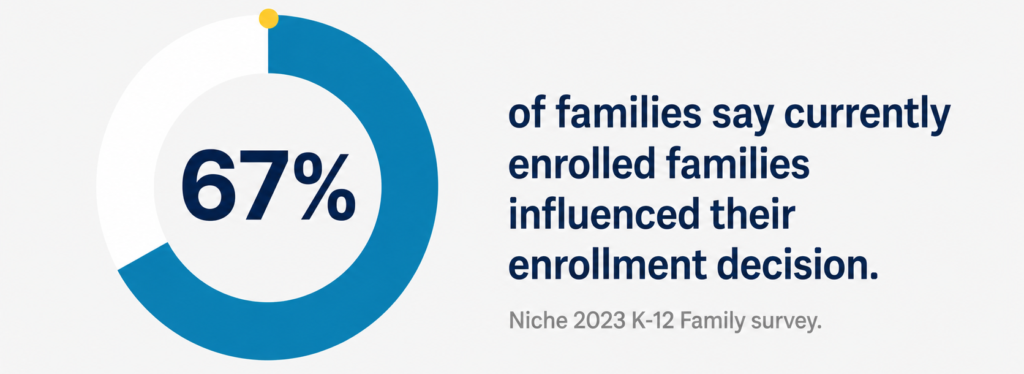
In most communities, a personal recommendation carries more weight than anything you can say about yourself. According to Niche’s K-12 parent survey, 67% of families say currently enrolled families influenced their enrollment decision.
Your enrolled families are your most valuable marketing asset. A few ways to put that to work: give enrolled families language they can use when someone asks about your school. Ask for introductions directly, since families who are happy with your school will often refer others if you simply ask. Share testimonials and family stories (with permission) on your website and social channels.
Building a culture where enrolled families talk about your school is one of the highest-return things you can invest in, and it costs almost nothing.
Stage 4: Getting to Yes (The Decision Stage)
When a family is seriously considering enrollment, three things tend to determine whether they commit: clarity, confidence, and what we’d describe as natural urgency.
Clarity
At this stage, families have questions they haven’t asked yet. They want to know exactly what enrollment looks like, what the tuition structure includes, what their child’s day will feel like, and what happens if it doesn’t work out. The more directly and openly you can answer those questions, the easier it becomes for a family to say yes.
Make the enrollment process simple and transparent. A complicated multi-step process with long gaps between steps loses families who were otherwise ready to commit. Every step should have a clear next step, no dead ends, no form submissions that disappear into silence.
Confidence
The most powerful thing you can offer a family at the decision stage is evidence from other families who made the same choice. This is why enrolled families showing up at events, sharing their experience in your newsletter, or being available to speak with prospective families matters so much.
62% of families are open to a school operating in its first year. Families care more about the founder’s clarity of vision and responsiveness than about how many years the school has been open. What creates confidence isn’t longevity. It’s the sense that you know what you’re doing, you care about their child, and you’ll be honest when things come up.
Natural Urgency
There’s a way to create momentum without pressure. Countdown timers, “spots filling fast!” language, and artificial scarcity create anxiety rather than confidence, and they’re inconsistent with the kind of school most microschool founders are trying to build.
Real constraints work better and feel honest. If you’re opening with a cohort of 12 families, that’s a real number worth sharing. If families who join by a certain date can participate in onboarding, that’s a real timeline. Share those facts clearly and let families make decisions at their own pace, with the honest understanding that timing matters.
Follow up after tours and info sessions, not aggressively but consistently. Many families who seem to go quiet are still deciding. A short, personal note a week or two after an event often restarts conversations that seemed finished.
Frequently Asked Questions About Microschool Marketing
When should I start marketing my microschool?
Earlier than feels comfortable. Enrollment conversations work best when they happen alongside the process of building your school, not after it. Early conversations help you understand what families in your community value, which often shapes your decisions about curriculum, scheduling, and structure. Starting outreach 6 to 12 months before your planned opening date is reasonable for most founders. For more on building a school from the ground up, see our guide on how to start a microschool.
Do I need a website before I start talking to families?
No. A basic Google Business Profile, a one-page website, and an active presence in local community spaces can carry you through early outreach. What families need before a polished website is a reason to trust you, and that comes from meeting you, hearing your story, and seeing your commitment to the work. Build your digital presence in parallel, but don’t let the absence of a finished website delay the conversations.
Should I run paid ads for my microschool?
Paid advertising has a role later, but early enrollment momentum almost always builds from visibility, consistency, and genuine relationships within your community. Most founders see better results from showing up consistently at local events and engaging their existing networks than from running ads to cold audiences. Ads work better once you have a defined audience, a clear message, and some social proof to point to.
How many students do I need to sustain a microschool?
Most microschools operate sustainably with a founding group of 8 to 12 students, depending on your tuition model and cost structure. Having a specific enrollment target in mind helps you set realistic milestones and gives families a clear sense of how the school will feel when it opens.
Building Marketing Into Your Microschool From the Start
Marketing is often one of the last things founders plan for, but it’s most effective when it’s built into the process from the beginning. In practice, that means starting enrollment conversations before you have all the answers, showing up in your community before you have a space, responding to every inquiry the same day, and building a founding group of families who become your first word-of-mouth ambassadors.
A simple four-week framework to get started:
Week 1: Get visible. Set up or clean up your online profiles, create one simple flyer, and post once introducing your school to your community.
Week 2: Build interest. Post three times (one student moment or learning example, one founder story, one FAQ). Announce an upcoming info session. Share in one or two local groups.
Week 3: Build trust. Host an info session, personally invite five families, and follow up with everyone within 48 hours.
Week 4: Move toward decision. Follow up with event attendees, clarify any timelines, ask for referrals, and share one testimonial or family story.
For founders who want ongoing support as they grow, the KaiPod Partner Network includes a directory listing on one of the most-trafficked microschool finder resources in the country, direct lead forwarding from families searching your area, and a Partner Success Manager for ongoing enrollment coaching.
The KaiPod Catalyst program exists to give educators structure, guidance, and community so you don’t have to figure everything out alone. It covers marketing, enrollment, and every other aspect of launching a microschool, drawing on the experience of a team that has worked alongside more than 150 founders across 30+ states. If you’re ready to take the next step, schedule a free consultation with our team to learn more.