A microschool is a small school, usually a mixed-age group of children learning together with one or two teachers, often in a home, a storefront, or space borrowed from a community organization rather than a traditional school building.
Microschools differ from each other in staffing, teaching approach, and how much they can take on. So when considering microschools for a neurodivergent child, it’s better to assess fit by asking questions about specific schools rather than about microschools as a category.
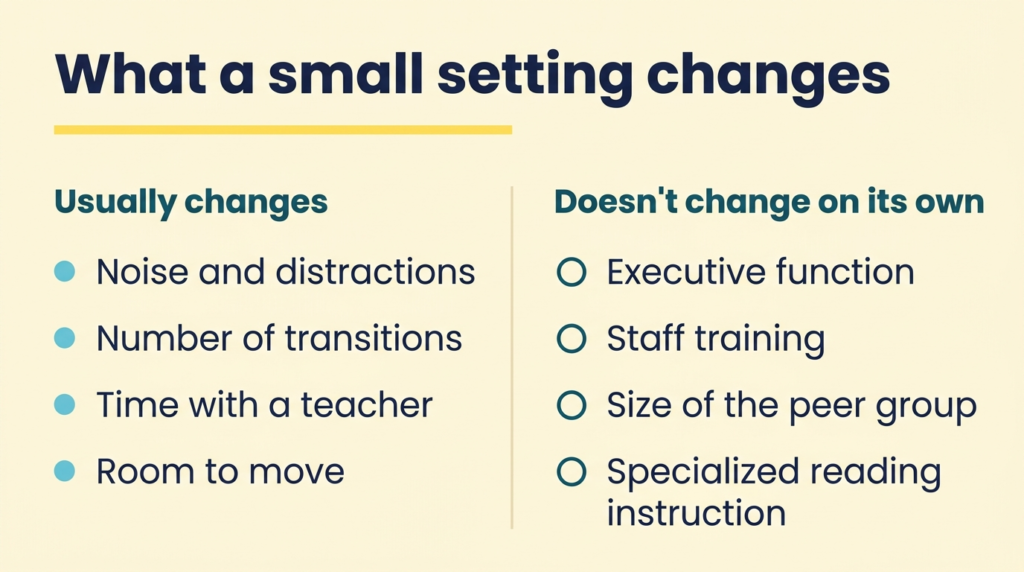
While a small group can lower sensory load and give a child much more time with a teacher, it can not substitute for speech therapy, structured reading instruction, or a behavior support plan.
At KaiPod Learning, we work alongside more than 150 microschool founders across 30+ states, and our Microschool Directory lists microschools across the country. Some were built specifically for neurodivergent learners. Many others serve a wide range of children and differ in what they can support.
Schools in our Partner Network are independently owned and led, and we don’t require a single curriculum or teaching model.
In this article:
- How many microschools serve neurodivergent students?
- What a microschool changes for a child with ADHD
- Microschools and children with autism
- Microschools, dyslexia, and other learning differences
- Microschools and twice-exceptional children
- What happens to an IEP and services if you leave a public school
- Signs a microschool may be a good fit for your child
- When another option may fit better right now
- Microschools built for neurodivergent learners vs. general microschools
- Questions to ask the microschool you’re considering
- How microschools compare with your other options
How Many Microschools Serve Neurodivergent Students?
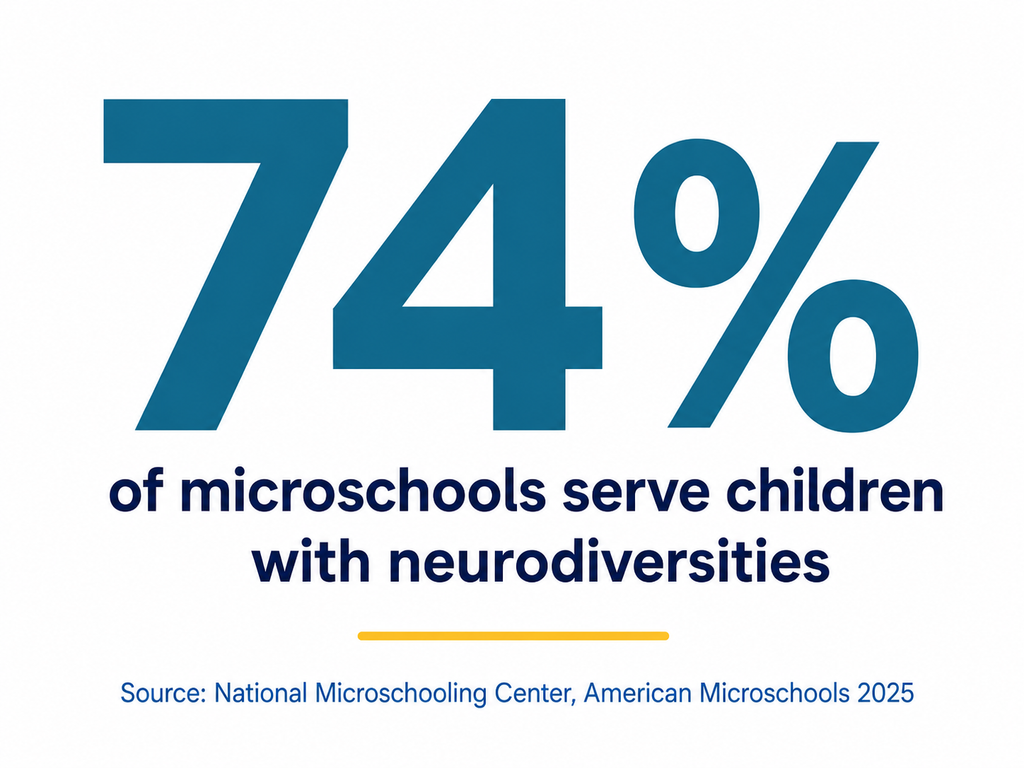
Most microschools serve at least some neurodivergent children. In a 2025 analysis of 800 operating and prelaunch microschools across all 50 states and the District of Columbia, the National Microschooling Center found that 74% of microschools serve children with neurodiversities.
Many microschools were started by educators who wanted to teach differently, and some by families who went looking for the setting their own child needed and decided to build it.
Your child would not be the first neurodivergent student a school has enrolled. A sector-wide figure still can’t tell you whether a particular school is set up for your child, which is the part that shapes their day.
If you’re still getting oriented to the model itself, our post on what a microschool is covers the basics, and how microschools work walks through the daily structure.
What a Microschool Changes for a Child With ADHD
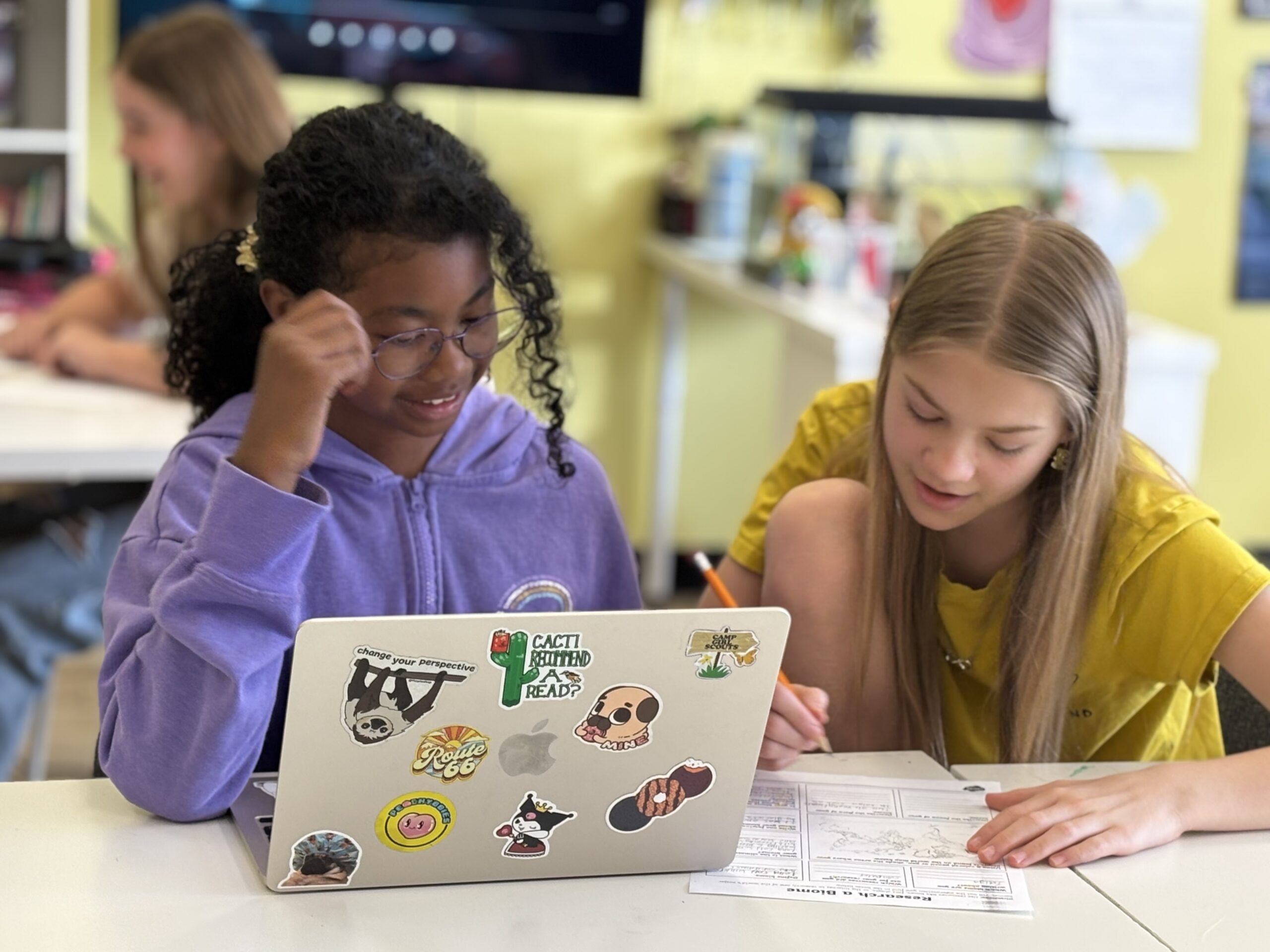
A smaller room is a quieter room. Fewer children means fewer competing sounds and movements, and the teacher is a few feet away rather than across a larger space. A child can stand up, move, or step out for a minute without it becoming something everyone notices.
However, starting a task, keeping track of time, holding several steps in mind, and knowing when to ask for help are executive function skills, and none of them change with the size of the room.
Some microschools lean heavily on self-directed work with long open blocks, and for a child who has trouble getting started, an open block can be harder than a more structured classroom.
CHADD, the national ADHD organization, publishes guidance for educators on classroom accommodations that help students with ADHD. Much of that guidance comes down to explicit structure: routines the child knows by heart, instructions given in writing as well as out loud, long assignments broken into smaller parts, and a check-in to confirm the child understood before they begin.
A small setting works well for a lot of children with ADHD when the day has enough structure in it. Families often find it useful to ask how much of the day is teacher-directed, and how a child who hasn’t started an assignment gets noticed. Schools that have a system for this can usually describe what it looks like.
Microschools and Children With Autism
For many children with autism, a large school building takes energy to manage. Hallway noise, the cafeteria, several transitions before lunch, and a different teacher each period add up over the course of a day. Energy spent managing noise and crowds is energy that isn’t going into learning or into other people.
In a microschool, the same one or two educators are there all day, the routine is predictable, and the space is small enough to be known, so there is far less environment for a child to manage. Many families notice a child coming home with more energy left before they see any change in schoolwork.
However, a small school also means a smaller peer group. A school with fifteen or twenty children spread across several grade levels may have only one or two close to your child’s age, and if a friendship doesn’t work out, there isn’t another class to move into. We look at this more closely in our post on socialization in microschools.
A small room helps most when the educators in it are trained to read what’s happening underneath a hard moment. Asking what a hard day looks like tends to be revealing. Some schools will describe a quiet space and a written plan. Others will tell you they call families to come pick up, which is far better to know before you enroll than after.
If you’re looking specifically for schools built around students with autism, you can filter by Specialized Learning Needs in our Microschool Directory to see which schools near you describe themselves that way.
Microschools, Dyslexia, and Other Learning Differences
A child with dyslexia in a class of eight gets more of the teacher’s attention than the same child in a class of twenty-five. However, if that teacher isn’t trained in structured reading instruction, the extra attention may not meet the child’s needs.
Children with reading difficulties tend to make progress with explicit, step-by-step instruction from someone trained to teach it, an approach often called Structured Literacy. Programs built around it (e.g., Orton-Gillingham and Wilson) follow that sequence closely. Written expression and math also need direct instruction in the specific skill.
A warm, attentive school can still leave reading time to a self-paced app or to independent reading. While a child may be happier there, the underlying difficulty with reading isn’t addressed.
Specialized reading instruction is its own skill set, and attention is not a substitute for it. It’s fair to ask what training the staff hold, by name, and how progress is measured and how often. Nationally normed assessments given a few times a year (e.g., MAP Growth from NWEA or DIBELS) tell you more than completion percentages or badges from a learning app.
Some microschools will say plainly that reading support isn’t their strength and that families arrange it outside of school. Knowing where a school’s limits are makes your decision easier rather than harder.
Microschools and Twice-Exceptional Children
A child who is gifted and neurodivergent needs to move ahead where they’re strong and get real support where they’re not, and most school schedules treat those as opposites.
A microschool is often better positioned for both needs at once than a graded classroom is. Children of different ages frequently learn together, and a child can usually move on once they’ve mastered something rather than when the calendar says to. Multi-age grouping and mastery-based pacing make it possible to work well ahead in one subject while getting support in another.
A school organized mostly around helping children catch up can leave a twice-exceptional child bored, and a school built entirely around self-directed interest work may never get to the handwriting, organization, or reading support the same child needs.
A school that has taught a twice-exceptional child before can usually describe how it handles a child who is two grade levels ahead in one subject and needs significant support in another.
What Happens to an IEP and Services If You Leave a Public School
Many families worry that moving their child means giving up services they worked hard to secure, and this is the part of the decision that tends to stall longest.
In general, an IEP is tied to enrollment in the public school system, and most microschools are set up either as private schools or for families who register as homeschoolers. That change in enrollment is what shifts the district’s obligations.
Districts do set aside a portion of federal special education funding for what are called equitable services, which go to students whose families have placed them privately. The district decides which students receive them and where. The U.S. Department of Education’s questions and answers on children placed by their parents in private schools explains the process in detail.
| While enrolled in public school | After enrolling in most private or homeschool-registered microschools | |
| The IEP | An enforceable plan the district must follow | Generally becomes inactive; some districts write a more limited services plan instead |
| Speech, OT, and behavior support | Provided and funded by the district as written | May be available in limited form through the district, otherwise arranged and paid for by the family |
| Where services happen | At your child’s school | Decided by the district through consultation; may be at the microschool or at another site |
| Evaluations | Conducted by your district | Your district, or the district where the microschool is located, generally still evaluates at no cost to families |
| 504 plan | Applies | Generally doesn’t apply to private schools that don’t receive federal funding |
| Disability protections | ADA Title II | Generally ADA Title III, which requires reasonable changes to policies but not specialized staff or individualized programs |
| If you disagree with the school | Full dispute process through the district | Generally limited to questions about evaluation and identification |
| Returning to public school | Not applicable | The district makes services available again and the team writes a new plan; the previous IEP isn’t automatically reinstated |
Rules vary by state, and by whether a school is secular, religious, or homeschool-registered, so confirm what applies where you live.
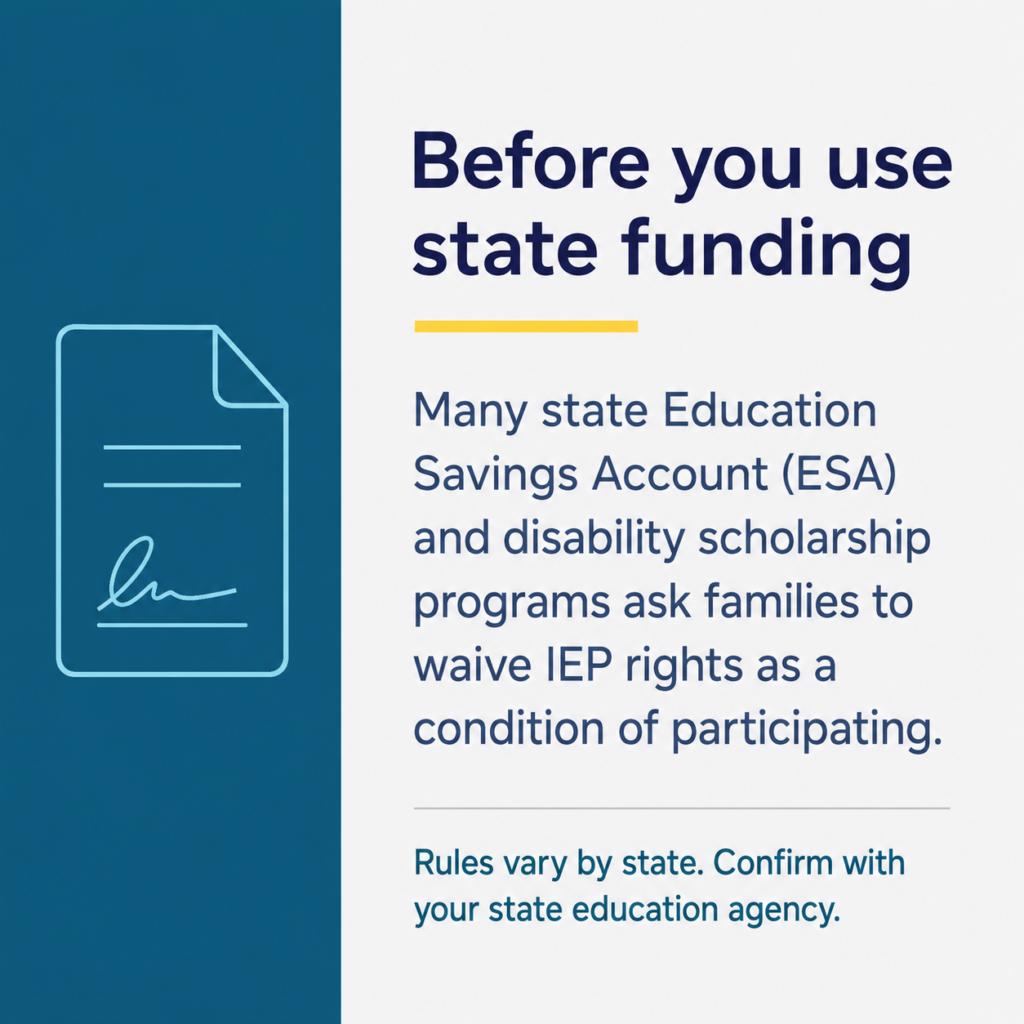
If you plan to use a state Education Savings Account (ESA) or a disability scholarship toward tuition, read the program terms closely. Some programs ask families to acknowledge that certain rights under federal special education law change as a condition of participating. Our post on state programs that help pay for private school covers how these work, though rules vary by state and change often.
We can’t provide legal advice, and none of this replaces a conversation with the people who know your child’s file. Your child’s current school team and your state education agency can clear up most of it. Ask your district what equitable services look like in your area this year, and ask the microschool you’re considering to put in writing what it will and won’t provide.
Going into this decision knowing what the district will fund and what the school will provide tends to make it feel much steadier.
Signs a Microschool May Be a Good Fit for Your Child
A microschool tends to be worth exploring when several of these are true:
- Most of what’s hardest about school is environmental: noise, crowds, transitions, the size of the building, or the number of teachers your child moves between.
- Your child can work in a small group with periodic check-ins rather than needing continuous one-on-one help to get through the day.
- Your child is ahead in some areas and needs support in others, and grade-level pacing has been a poor fit in both directions.
- Any therapy your child receives is already private, or your family can arrange and fund it outside of school.
- School has become a real source of stress at home, and the current setting hasn’t been able to shift that. Our post on reasons families switch schools covers how families weigh that decision.
When a child is refusing school, or coming home overwhelmed most days, lowering the daily demands often helps. The Child Mind Institute’s work on how anxiety affects children at school is a useful read on why.
A smaller setting can interrupt a cycle of daily school refusal, though it won’t treat an underlying anxiety disorder on its own. If your child is already working with a clinician, that’s a good conversation to have with them alongside the school search.
When Another Option May Fit Better Right Now
A different setting is often the better fit when:
- Your child receives daily speech, occupational, physical, or behavioral support that is built into the school day and funded by the district.
- Your child needs specialized instruction in reading or math, and the schools you’re looking at don’t have staff trained to deliver it.
- Your child has safety needs that require staff trained in crisis response.
- You need the ability to formally dispute decisions and to require specific services and hours.
- The budget can’t absorb outside therapy costs on top of tuition, even with state funding.
Choosing something else this year doesn’t close the door on a microschool later. Families come back to it after a diagnosis gets clearer, after services are stable, or when a school opens nearby that’s built for a child like theirs.
Microschools Built for Neurodivergent Learners vs. General Microschools
A general microschool that welcomes a range of learners can be a strong fit for a child whose needs are mostly about environment and pacing. Our network includes schools designed around a specific learning profile and schools that serve a mix.
| Built for neurodivergent learners | General microschools serving a range of learners | |
| Designed around | A specific profile, such as autistic students or children with learning differences | A mixed group with varied strengths and needs |
| Staffing | Often includes special educators, trained reading specialists, or behavior support staff | Usually generalist educators, sometimes with specific training or outside consultants |
| Peer group | Peers with similar profiles and experiences | A mix, which some children find easier and others find harder |
| Daily structure | Sensory planning, visual routines, and support built into the schedule | Small-group structure that can often be adapted, though the framework varies |
| Outside providers | Frequently coordinate with therapists, sometimes on site | Usually family-arranged, with varying flexibility on scheduling |
| Worth asking about | Cost, availability nearby, and whether the peer group fits your child socially | What specific supports exist, and how the school handles a need it isn’t set up for |
You can filter by location in our Microschool Directory to see what’s near you, and the listings will give you a sense of which category a school falls into.
Questions to Ask the Microschool You’re Considering
Most schools describe themselves as personalized and welcoming of all learners, and most of them mean it. A question that calls for a specific answer will still tell you more.
| Ask | A substantive answer sounds like | A general answer sounds like |
| How do you support a child who learns differently? | A description of two or three real children, what was adjusted, and what stayed the same | “We meet every child where they are” |
| What training does your staff have for this? | Named certifications, who holds them, and when they were completed | “Our teachers have a lot of experience with different learners” |
| How do you measure academic progress? | A named assessment, given on a schedule, plus how results are shared with families | “Portfolios and teacher observation” |
| What happens on a hard day? | A described routine, a specific space, and when families get called | “We handle it case by case” |
| Can outside therapists work with my child here? | A clear yes or no, with scheduling logistics and any space limits | “We’re happy to collaborate” |
| What records will we have if we move schools later? | Transcripts, course descriptions, assessment history, work samples | “We can put something together” |
A vague answer usually just means you need to ask a follow-up question. A school that tells you plainly what it can’t do is giving you useful information, not a warning sign. Our 2026 Family Guide to Microschools includes a school visit worksheet you can bring along and fill out afterward, while it’s fresh.
How Microschools Compare With Your Other Options
A microschool belongs on a list with your child’s current school and IEP team, other public options including specialized programs in or outside your district, private schools built for specific learning profiles, and homeschooling with outside support.
We’ve written comparisons of microschools and homeschooling and microschools and private schools, along with an overview of microschool pros and cons.
Whichever direction you go, the decision comes down to one specific school and what it can do for your child. Asking each school on your list the same questions is the fastest way to find that out.